
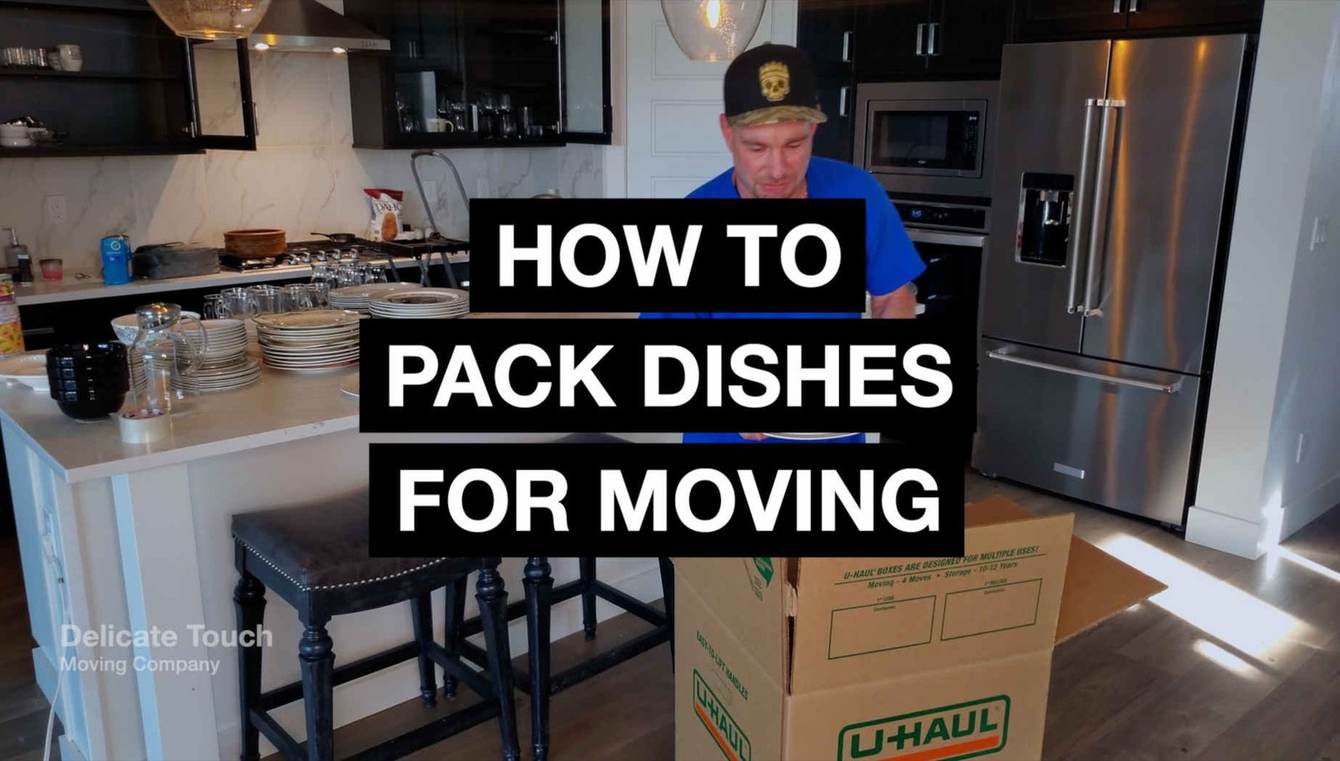
Wrap every piece on its own, stand plates on edge instead of stacking them flat, fill every gap until nothing can move, and keep the box small enough to lift without straining. Get those four right and the dishes arrive whole. Everything below is the detail behind them.
What you need
- Dish packs, or small double-walled boxes. Not a large box. A large box full of plates is a box nobody can carry safely, and it is the one that gets dropped.
- Plain packing paper. Not newspaper. The ink rubs off onto everything it touches, and you end up washing every plate twice at the other end.
- Good tape and a marker.
If we are doing the packing, boxes and packing paper are billed separately. The pads, straps and shrink wrap we use on furniture are already part of the hourly rate.
Tape the bottom before anything goes in
One strip along the center seam, one across each end, then one around the bottom edge. A dish box fails from the bottom, and it fails while someone is holding it. That is not the moment to find out the tape was an afterthought.
Start with a cushion
A few inches of crumpled paper across the bottom, before the first dish. It is what the box lands on when it is set down harder than anyone meant to set it down.
Plates stand on edge
This is the one change that saves the most. Stacked flat, each plate carries the weight of everything above it across its widest, weakest surface. Stood on edge, it carries that weight on the rim — which is the part that was made to take it.
Wrap each plate on its own, a few at a time. Stand them upright in the box like records in a crate, with crumpled paper between them and along the sides. Bowls go the same way, or nested with a sheet of paper between each one.
Cups and glasses go in last
Wrap each one individually, and push a little crumpled paper inside before you wrap it so the walls have something to lean on. Put them in the top layer, where the least weight sits above them. Stemmed glasses need the stem wrapped on its own first — the stem is where they break.
Heavy at the bottom, light at the top, and nothing touching anything else.
The shake test
Before you seal the box, close the flaps and give it a gentle shake. If anything shifts or clinks, it will shift and clink on the truck, for a lot longer and a lot harder. Add paper until the box is quiet.
A quiet box is a packed box. A box you can hear is not finished.
Label it for someone else
Write FRAGILE in large letters, the room it goes to, and which way is up — on two sides, not just the top, because the top is the side nobody can see once boxes are stacked. Assume someone other than you will carry it. On moving day, someone probably will.
Keep one box out
Pack a small box last with a plate, a bowl, a mug and a set of cutlery for each person, plus a knife, a pan and dish soap. Label it OPEN FIRST and keep it with you, not on the truck. It covers the last night in the old place and the first morning in the new one, and it means nobody has to dig through twelve dish packs to find a coffee cup.
Half-packed is the slowest version
If moving day is close and the kitchen is not done, it is worth knowing that a half-packed kitchen usually takes longer than one that has not been started. The crew has to stop, work out what is ready to go and what is not, and finish the rest around it. Our page on last-minute moves covers the other things that quietly stretch a day.
If you would rather not do it yourself
Kitchens are slow to pack well, and dishes are the part of a move where care costs time. If you would rather hand it over, our packing service covers the kitchen along with the rest of the house, and you can choose to have us pack only the fragile rooms.
Tell us what you have and where it is going, and we will quote it. Or call 208-713-4216.